Govern
Record/version, authority, retention and holds

Connect records lineage to Mobile-ID’s published LTANS capability; agree the Records configuration in a contract and profile.
Record/version, authority, retention and holds
Source bytes, replicas, locations and operator permissions
Formats, representation information, migration/lineage
Contract-specific validation, profiles, receipts, renewal and verification
Restore operations without replacing preservation layers
Choose preservation configurations by record class, designated community and required evidence. Illustrative profiles are not approved service offerings.
Read detailsStandards → controls → workflows → contracts → evidence. Reference design mappings rather than Trusted Records certification.
Read detailsExercise a records workflow with forms, requests/responses and a timeline. Use synthetic data in offline simulation or a local HTTP mock.
Read detailsMobile-ID lists LTANS Archiving in its TrustedHub brochure. Records connectivity, storage models, profiles and detailed API/SDK contracts are unverified.
TrustedHub · Mobile-ID ↗| Stage | Decision | Evidence and exceptions |
|---|---|---|
| Admission | Are validation/hashes/profiles eligible? | Quarantine mismatches; do not submit to the provider |
| Provider submission | Correct storage model, scope and request reference? | Timeout: query before retry; retain INDETERMINATE |
| Receipt recording | Does binding match record/version/hash/profile? | Missing/mismatched receipts cannot become VERIFIED |
| Monitoring | Does policy/crypto/format require strengthening or migration? | Retain old/new evidence lineage; escalate failures |
| Export | Is the recipient authorized and what retention survives? | Manifest, evidence, verifier and retained-copy inventory |
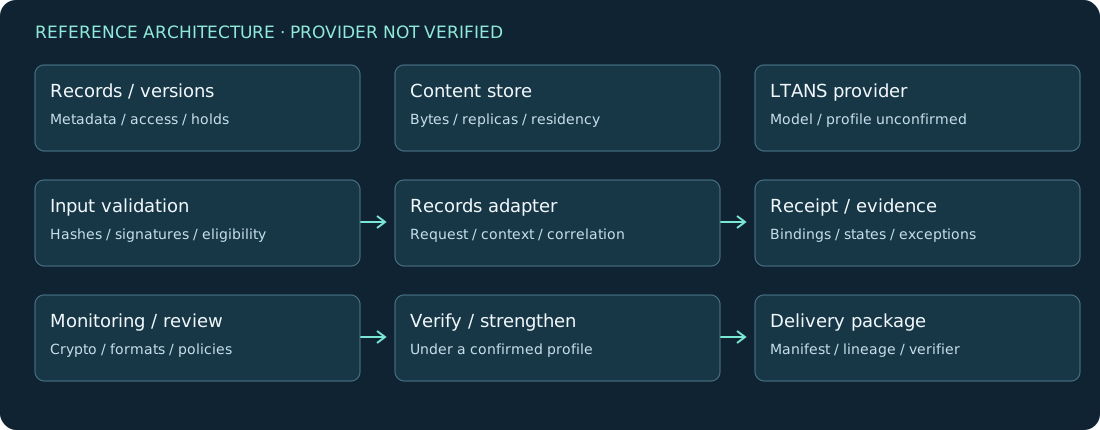
Mobile-ID’s TrustedHub Signing & Verification Appliance brochure lists LTANS Archiving among notary/archive/timestamp/evidence-archive capabilities. It does not verify a Records connector, endpoint, content-storage model, profile or SLA. This page defines reference integration boundaries rather than an accepted LTANS deployment.
Records governs objects, versions, permissions and manifests. Content stores have their own owners, residency and replicas. Evidence-preservation services accept profile-bound inputs and return receipts/evidence; content storage, temporary storage or no-content-storage depend on the contract. Backup/DR restores service and does not replace readability or long-term evidence preservation.
Check hashes/manifests, signature-covered objects, initial validation and profile-selection authority. Bind receipts to record/version/hash/profile/provider. Missing receipts or timeouts remain indeterminate; query/reconcile before resubmission. New timestamps do not repair missing original authenticity grounds.
Retain policy/profile versions, evidence references, verification states and provider-specific strengthening events. Hash mismatches, failed validation, incompatible profiles or renewal failures require owned exceptions. Retrieval/export includes originals, metadata, manifests, lineage and verification instructions; identify retained data under retention/holds.
Connect paper and born-digital records through persistent identifiers, policies and evidence.
Read detailsExercise ingest → job tracking → registration → verification with synthetic data.
Read detailsEach evidence type answers a different question; hashes, timestamps and approvals are not interchangeable.
Read detailsAgree record classes, quality criteria, permissions and evidence before scaling.
Plan assessment